How to Grow Your Home Service Business with AI Automation in 2026
I. Introduction: The "Instant-Everything" Service Era
The home services industry is currently navigating a period of unprecedented structural change, moving from reactive manual labor models to proactive, technologically augmented operational frameworks. This evolution is driven by a convergence of macroeconomic stressors, including a chronic shortage of skilled tradespeople, volatile material costs, and a fundamental shift in consumer behavior toward a preference for "instant-everything" service delivery. As the sector moves into 2026, the application of artificial intelligence (AI) and high-level automation has transitioned from a competitive advantage to a foundational requirement for organizational survival.
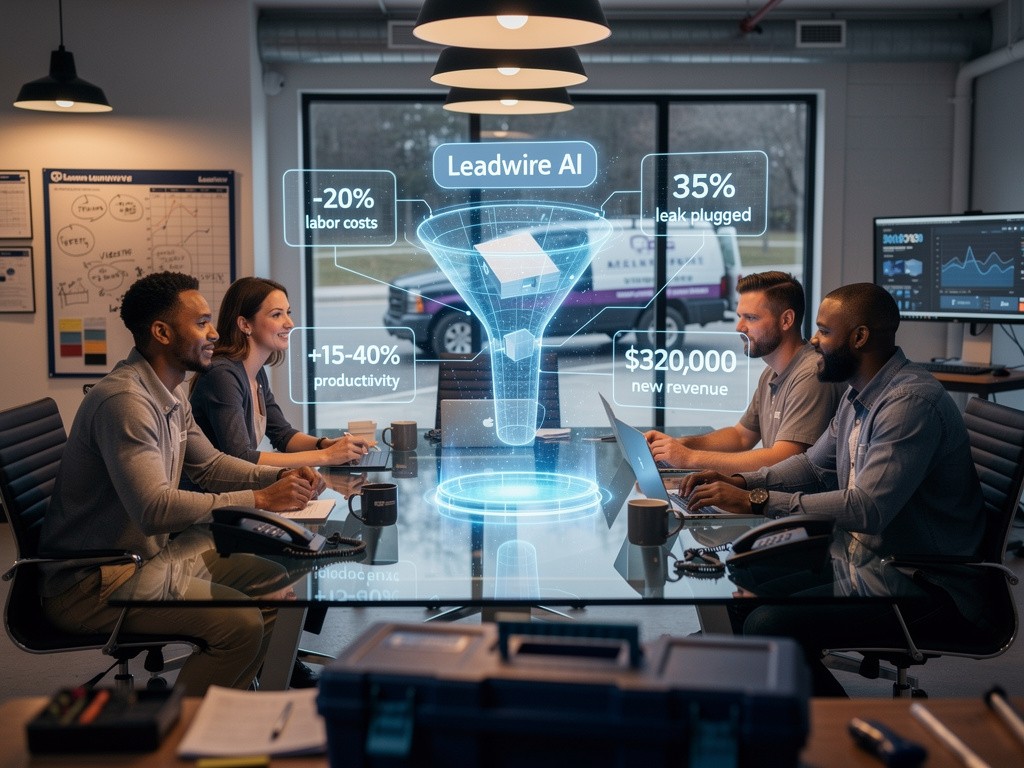
Research indicates that home service organizations implementing integrated AI-driven resource planning can achieve labor cost reductions of approximately 20% and productivity increases ranging from 15% to 40%. With AI adoption rates hitting 72%, demand for these products is expected to climb by 21% annually through 2030. At Leadwire AI, we view automation as a "force multiplier" for entrepreneurs—a tool that makes your existing team of ten act like, feel like, and do the work of twenty.
II. Plugging the "Leaky Funnel": 24/7 Intelligent Lead Capture
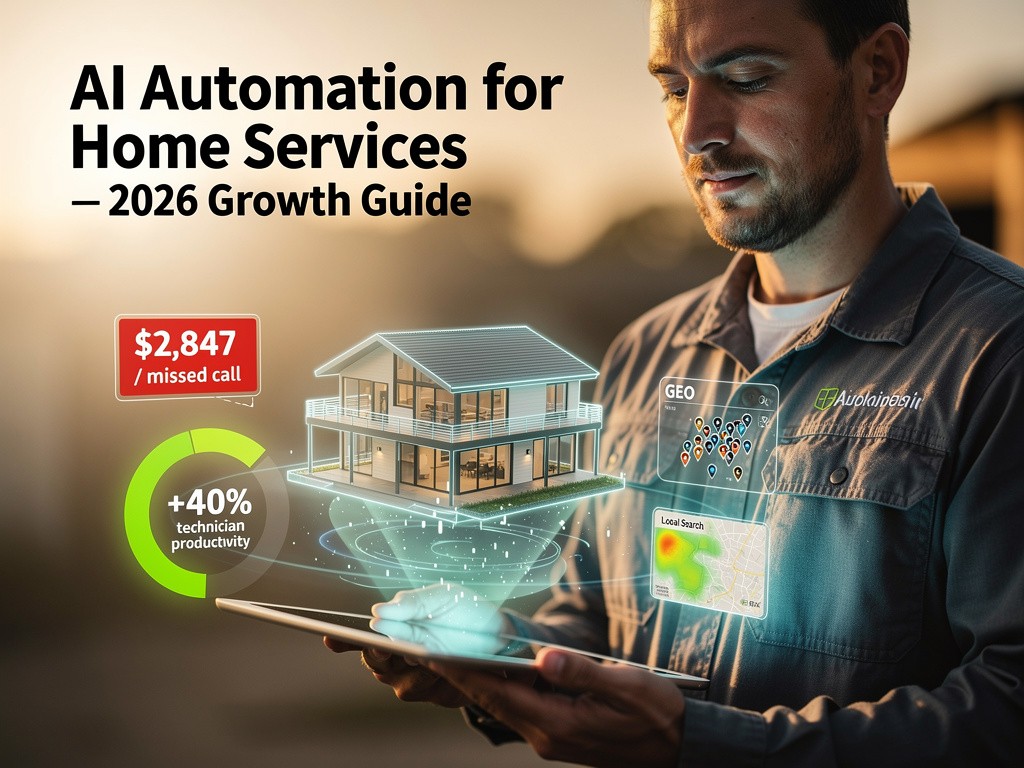
Capturing a lead is only the first step; conversion requires an instantaneous response. Research shows that the average home service business loses approximately 35% of its potential leads due to missed calls or delayed responses. This "leaky funnel" represents a massive revenue drain, especially since nearly 70% of customers choose the business that replies first. In the roofing industry, every missed call costs contractors an average of $2,847 in lost revenue.
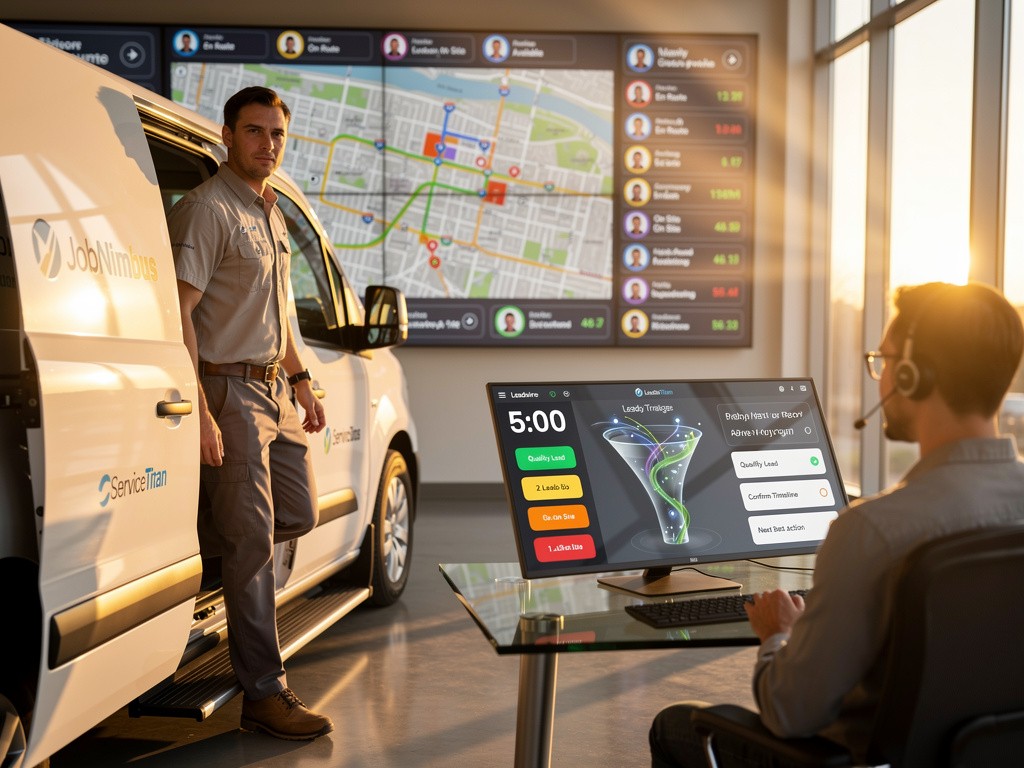
To combat this, elite teams are turning to AI voice agents and intelligent chatbots to provide 100% answer rates. Specialized tools like Leadwire AI utilize Natural Language Processing (NLP) to understand industry-specific terminology like "shingles" or "coils" and can process urgency and emotion in real-time. The financial impact of this "speed-to-lead" is profound; responding within 5 minutes of an inquiry increases the chances of securing a job by 100x compared to waiting 30 minutes. Companies implementing these solutions report up to a 340% increase in qualified leads within the first 90 days of deployment.
III. Operational Efficiency: Turning "Wrench Time" into Profit
In the trades, profitability is a function of "wrench time"—the actual hours a technician spends performing billable work versus driving or doing paperwork. AI serves as a growth lever by automating administrative burdens that typically consume 30 to 90 minutes of a technician's day.
Algorithmic Scheduling and Dispatching: Field service management (FSM) platforms like ServiceTitan, Zuper, and Jobber use AI to suggest the optimal technician for a specific call by analyzing historical job data, skills, and real-time traffic. These systems can double the capacity of dispatchers, allowing them to manage more jobs without compromising quality.
Route Optimization: AI-led smart routing makes real-time adjustments based on traffic patterns to minimize travel time and fuel consumption. By calculating the most fuel-efficient paths, AI allows technicians to fit an average of one additional job per day into their schedule.
Predictive Inventory: AI systems integrate with supplier databases to predict part requirements before a truck even leaves the warehouse, reducing excess inventory carrying costs by up to 30%.
IV. Trade-Specific AI Applications: A Deep Dive
The effectiveness of AI is maximized when applied to the specific technical challenges of individual trades.
HVAC & Plumbing: The industry is moving toward a proactive "predictive diagnostics" model. AI-powered tools like MeasureQuick and BrainBox AI analyze real-time system data to identify anomalies like refrigerant leaks or strange vibration patterns before a failure occurs. Plumbers are now using AI-equipped cameras to inspect pipes for blockages in real-time, predicting failure points that the human eye might miss.
Roofing: Safety and accuracy are the primary drivers for roofers. AI-driven drone inspections using RoofSnap or EagleView identify storm damage 70% faster than manual ladder climbs. Platforms like Hover produce 3D models from smartphone images, enabling instant, accurate quotes that previously took hours.
Landscaping: AI revolutionizes bidding through satellite measurement. Tools like PropertyIntel and SiteRecon use machine learning to "auto-detect" turf and asphalt, providing accurate measurements in seconds to increase "win rates" without site visits. Additionally, professional robotic lawn mowers are expected to reach a $1.4 billion market by 2025, allowing crews to focus on higher-margin services like hardscaping.
V. The New Search Frontier: GEO and AEO
Traditional SEO is being superseded by Generative Engine Optimization (GEO) and Answer Engine Optimization (AEO). Today, homeowners find contractors through AI summaries, map packs, and conversational engines like ChatGPT, Perplexity, and Gemini. To remain visible, your brand must become the "cited authority" in these AI-generated answers.
AI-powered SEO platforms now leverage machine learning to prioritize high-intent "emergency" searches over casual research queries. Furthermore, AI tools automate the maintenance of Google Business Profiles (GBP), ensuring descriptions and service hours are optimized for the latest algorithmic preferences. By implementing a [GEO Strategy: How We Rank You in ChatGPT & Gemini], you ensure your business is recommended when a homeowner asks a voice assistant, "Who is the best plumber open near me right now?".
VI. The Economics of AI: Costs, ROI, and Implementation
While AI implementation is more affordable than ever due to the "AI-as-a-Service" model, understanding the total cost of ownership is essential.
Implementation Tiers:
Entry-Level (The "Self-Starter"): Basic tools for FAQ automation and review generation cost between $200 to $1000 per month.
Mid-Market (The "Integrator"): Solutions for companies with 10-50 employees typically range from $50,000 to $150,000, including CRM integration and staff training.
Enterprise (The "Market Leader"): Large-scale transformations can exceed several million dollars and involve custom analytics and data preparation.
Hidden Costs and ROI: Strategic planners should budget 15-25% of the initial cost annually for system monitoring and updates. Additionally, data preparation (cleaning historical records) often represents 20-30% of the initial budget. Despite these costs, the typical ROI timeline ranges from 3 to 9 months, with customer service AI showing returns in as little as 1 to 3 months.
VII. The 3-Phase Strategic Implementation Roadmap
High-growth companies avoid "tech fatigue" by following a phased plan:
Phase 1: The 30-Day "Quick Win": Audit your time and automate the "noisiest" part of the business, such as customer communication or review generation.
Phase 2: Operational Deepening (Months 2-6): Integrate AI scheduling, route optimization, and AI-assisted estimating to expand gross margins.
Phase 3: The Data-Driven Enterprise (Month 6+): Leverage predictive analytics to forecast seasonal demand and identify upselling opportunities before they manifest.
Analogy for Understanding: Implementing AI in your business is like upgrading from a manual hand saw to a high-end power saw. It doesn’t replace the carpenter’s eye for detail or their skill in building a cabinet, but it allows them to cut straighter and faster, finishing a week’s worth of work in a single afternoon.
FAQ Ideas
Will AI replace my technicians? No. AI handles repetitive "busy work" (scheduling, admin) while human technicians focus on physical craftsmanship and problem-solving.
Is AI too expensive for a small business? Most basic tools cost between $200–$900 per month—less than a part-time admin—and usually pay for themselves within 60 to 90 days.
What is the best AI tool to start with? AI-powered customer communication (chatbots or voice agents) typically offers the fastest results in lead capture and response times.
Internal Link Targets
• [Our 24/7 AI Voice Agent Solutions]: [Click Here]
• [GEO Strategy: How We Rank You in ChatGPT & Gemini]: [Click Here]
• [Guide to AI-Powered Lead Qualification]: [Click Here]
• [Case Study: 340% Lead Growth for HVAC Contractors]: [Click Here]
Sign Up to Our Newsletter
Subscribe to receive updates and automation tips straight to your inbox.
Recent Articles
AI automation insights to help your business move faster and smarter.